About Molecular AI Specialization
A focused 6-month program designed to guide you through applying machine learning and artificial intelligence in small-molecule drug discovery.
4 min read
October 12th, 2023
Last updated: October 31st, 2025
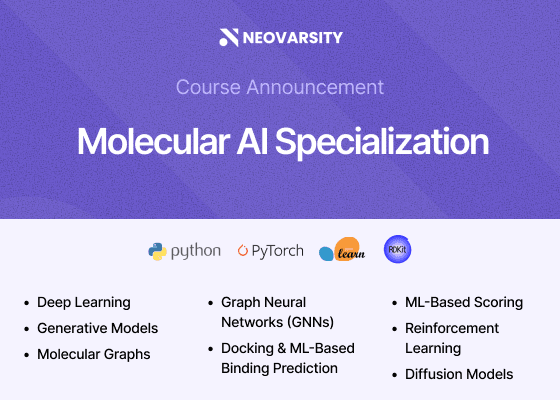
What is Neovarsity’s Molecular AI Specialization?
AI in drug discovery has been noisy. For years, the field was filled with flashy demos, vague claims, and academic prototypes that didn’t translate to real drug discovery workflows.
That phase is over. The field has evolved. So should the way we learn it.
Today, we are more aware of what works and what doesn’t. From robust cheminformatics pipelines to graph neural networks and 3D-aware generative models, the science has matured. AI is no longer a side project in pharma, it’s a core capability. But to work in this space, you need more than just surface-level knowledge or a pre-trained model.
You need depth, clarity, and hands-on skill. That’s what the Molecular AI specialization is designed to deliver.
In this blog, we’ll walk you through what the specialization covers, who it’s built for, and why it’s a strong launchpad for a serious career in AI-driven drug discovery.
For Learners Eager to Do Real Work in Molecular AI
Whether you’re starting from scratch or transitioning from chemistry, biotech, or machine learning, this is the most comprehensive, and structured path to mastering AI for small molecule discovery.
Over six months, you'll build real-world skills through live instruction, 3 mini-projects, and a capstone pipeline mirroring the workflows in modern molecular AI teams.
What You’ll Learn
Cheminformatics & molecular data engineering: Build a deep foundation using RDKit, fingerprints, descriptors, and curated data pipelines.
Machine learning for QSAR & ADMET: Go beyond toy models. Learn how to evaluate, interpret, and deploy predictive models that hold up.
Deep learning & generative models: Train and apply VAEs, SELFIES-based generators, and reinforcement learning models to design new molecules.
Graph neural networks & structure-based AI: Learn GNNs, 3D binding-aware models, and how to build protein-ligand ML pipelines that scale.
Real-world pipelines: From dataset curation to virtual screening, scoring, and compound triage, you’ll build the full stack.
Why Learners Trust This Program
The Molecular AI Specialization is led live by practitioners at the frontier of machine learning and drug discovery. Each instructor brings direct experience from translational research and industrial R&D, ensuring that the learning stays grounded in real-world applications.
Participants work through three mini-projects and a capstone that reflects authentic workflows used in biotech and pharma. These aren’t just academic exercises. They're modeled on the kind of work done in competitive AI-for-drug-discovery environments.
Our alumni now contribute at leading biotech firms, AI-first startups, and academic labs focused on high-impact research. The program continues to attract professionals and researchers from both industry and academia who are serious about advancing at the intersection of molecular science and machine learning.
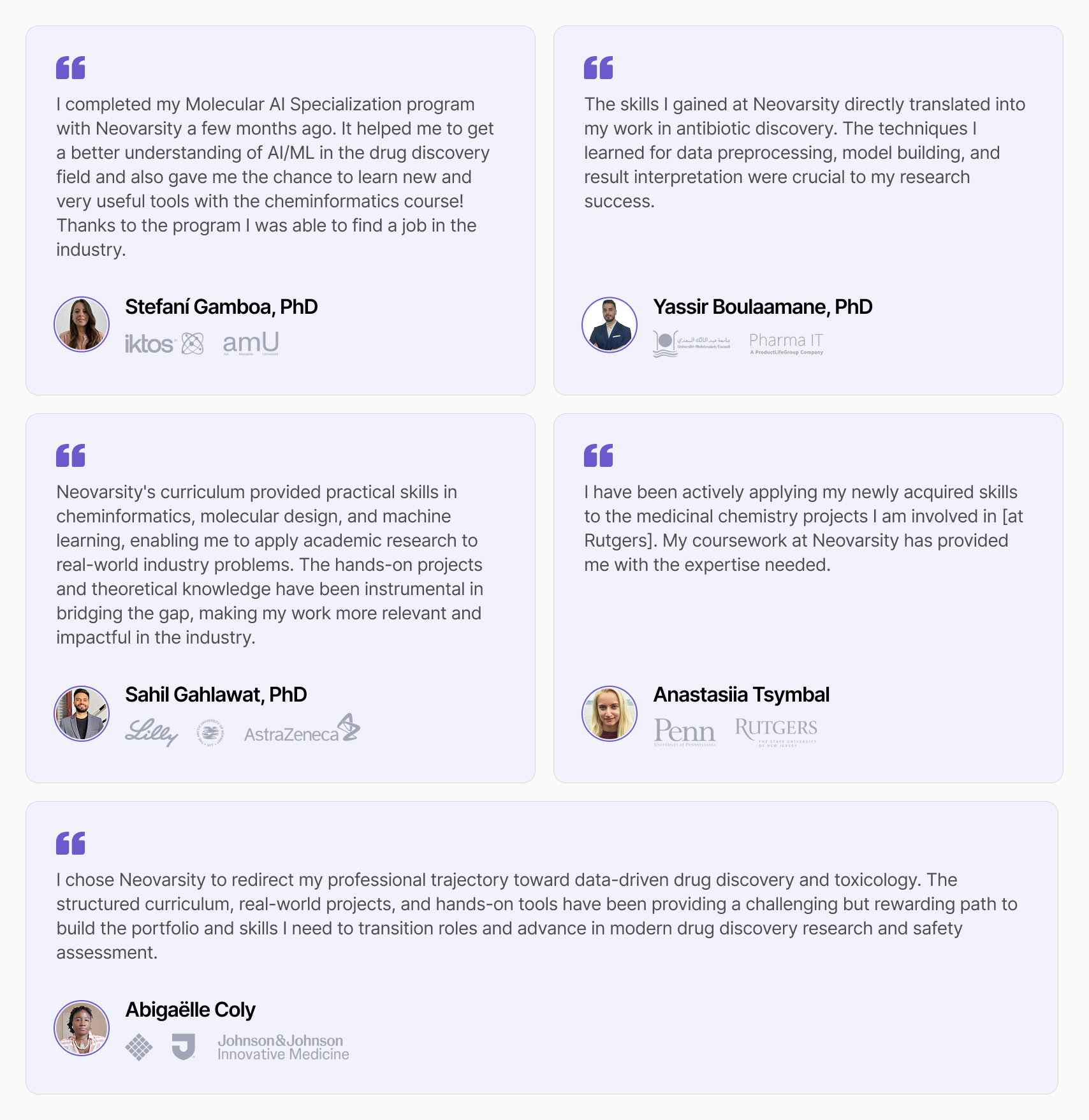
You can explore a few of the publicly-shared learner stories here.
Who It Is For
This 6 months, intensive Molecular AI specialization caters to a diverse group of professionals including but not limited to:
Computer-aided drug designers and computational chemists
Medicinal chemists and organic chemists
Chemical biologists
Machine learning engineers
Entrepreneurs building techbio ventures
Those intrigued by the intersection of AI and drug discovery
Who This Specialization Is NOT For
We designed this Molecular AI specialization for those who want to turn knowledge into real, working pipelines in AI-driven drug discovery. It’s more than just watching videos or re-running notebooks.
The program is rigorous, and it’s not for everyone.
This program is NOT for you if:
1. You’re looking for a quick-fix certificate to boost your CV. This is not a passive course. You won’t get value unless you show up, build, and reflect. We don’t hand out certificates for just attending, we expect real progress and engagement.
2. You’re unwilling to write code or touch the command line. We teach everything step-by-step, including Python, RDKit, and ML basics, but we assume you’re ready to get your hands dirty. If you only want GUIs or point-and-click tools, this isn’t the right environment.
3. You’re here for the hype, not the science. Molecular AI has had its buzzword moments. This program is for people who want to understand what’s under the hood, when to use a GNN vs a random forest, how to choose descriptors, why SELFIES matter. If you’re looking for plug-and-play shortcuts to molecule design without learning the fundamentals, you’ll struggle here.
4. You want to generate molecules without learning the biology or chemistry. While we don’t expect you to be a medicinal chemist, this program teaches molecule design in context. We care about why a molecule works, not just how to generate it. If you want to use AI as a black box without understanding the domain, this is probably not the right fit.
5. You’re not ready to commit 3 focused hours per week. We understand that life is busy, but this specialization only works if you invest the time to learn, practice, and build. If you’re not in a position to make that small weekly commitment, it’s better to wait until you are.
Curriculum Breakdown
MONTH 1 Foundations of Python, cheminformatics & molecular data
Week 1 Getting started with Python for molecular data
Top Skills: Python basics, scripting, data types
1.1: Python crash course - variables, loops, functions, data types
1.2: Pandas, NumPy, and matplotlib for molecular data (e.g., handling CSV/SDF)
Week 2 Handling chemical data with Pandas and RDKit
Top skills: RDKit, molecular parsing, descriptors
2.1: RDKit intro - molecule objects, SMILES, drawing, basic chemistry
2.2: Molecular descriptors (TPSA, logP), rule-based filters (Lipinski, PAINS)
Week 3 Molecular representations
Top skills: Fingerprints, similarity search, clustering
3.1: Fingerprints: ECFP, MACCS; similarity, Tanimoto metric
3.2: Substructure search, scaffold extraction, diversity analysis
Week 4 QSAR modeling with scikit-learn
Top skills: QSAR modeling, scikit-learn, train/test split
4.1: QSAR intro - basic ML concepts (features, labels, splitting)
4.2: scikit-learn models - Random forest, SVM, baseline training
MONTH 2 ML for molecules (from data to predictive models)
Week 5 Exploring and visualizing chemical datasets
Top skills: EDA, chemical space, t-SNE
5.1: Exploratory data analysis: distributions, outliers, chemical space (PCA/t-SNE)
5.2: Train/test split, cross-validation, metrics (ROC-AUC, RMSE, R²)
Week 6 Model evaluation and tuning for molecular prediction
Top skills: Hyperparameter tuning, model metrics, cross-validation
6.1: Feature selection, descriptor engineering
6.2: Hyperparameter tuning, pipeline building, grid/random search
Week 7 Model interpretation and avoiding common pitfalls
Top skills: Feature importance, SHAP, model bias
7.1: Model interpretation: feature importance, SHAP
7.2: Bias, data leakage, class imbalance, model validation traps
Week 8 Mini-project: Build your first QSAR pipeline
Top skills: Project scoping, model evaluation, reporting
8.1: QSAR mini-project kickoff (e.g., predicting solubility or kinase activity)
8.2: Project support session - model training + evaluation workshop
MONTH 3 Deep learning & generative models
Week 9 Introduction to deep learning for molecular properties
Top skills: Neural networks, PyTorch, MLPs
9.1: Neural networks - structure, forward/backward pass, loss
9.2: PyTorch intro - building MLPs with molecular fingerprints
Week 10 Molecular string representations
Top skills: SMILES, SELFIES, tokenization
10.1: Molecular representations: SMILES, SELFIES, tokenization
10.2: Build a SMILES-based autoencoder or VAE (concept + partial demo)
Week 11 Evaluating and refining generated molecules
Top skills: Autoencoders, latent space, molecule generation
11.1: Sampling, decoding, molecule validity/novelty/uniqueness
11.2: SELFIES for robust generation + decoding tricks
Week 12 Mini-project: molecule generation with VAEs
Top skills: Sampling, diversity metrics, filtering
12.1: Generation metrics, filtering, property control ideas
12.2: Mini-project: SMILES-based molecule generator + property scoring
MONTH 4 Molecular graphs & GNNs
Week 13 Molecules as graphs
Top skills: Graph theory, molecular graphs, Pytorch Geometric
13.1: Molecules as graphs - atoms, bonds, adjacency, features
13.2: PyTorch Geometric or DGL setup - data loaders, graphs from RDKit
Week 14 Training GNNs for molecular property prediction
Top skills: GNN training, message passing, regression
14.1: GCNs, message passing neural networks (MPNNs)
14.2: Train a GNN for property prediction (e.g., toxicity)
Week 15 Advanced GNN architectures and interpretability
Top skills: Graph attention, pooling, model interpretation
15.1: Attention mechanisms, graph pooling, deeper GNNs
15.2: Model interpretability + comparison vs. classical ML
Week 16 Mini-project: Comparing GNNs and traditional ML
Top skills: Model comparison, pretrained GNNs, scaffold analysis
16.1: GNN project kickoff (e.g., compare MLP vs. GNN for solubility)
16.2: Project review + bonus: MolCLR (pretrained GNN representations)
MONTH 5 Structure-based learning & generation
Week 17 Protein-ligand binding and structure-based learning
Top skills: PDB files, binding pockets, protein-ligand prep
17.1: Protein-ligand binding: PDB parsing, pocket identification
17.2: Docking concepts + running basic docking (e.g., Smina)
Week 18 Docking and ML-based binding prediction
Top skills: Docking, ML scoring, EquiBind/DiffDock
18.1: ML-based scoring functions: EquiBind, DiffDock (intro/concepts)
18.2: Pocket-conditioned generation (e.g., Pocket2Mol concepts, DiffSBDD)
Week 19 Reinforcement learning for molecular design
Top skills: Reinforcement learning, REINVENT, policy tuning
19.1: Reinforcement learning for molecules
19.2: Property-optimized generation: QED/logP optimization
Week 20 Modern generative models: diffusion, prompting, and beyond
Top skills: Diffusion models, GenAI, prompt-based design
20.1: Diffusion models for molecular generation (high-level)
20.2: Case studies of GenAI in pharma (BioMedLM, GaUDI, etc.)
MONTH 6 Capstone project
Week 21 Capstone planning and dataset exploration
Top skills: Project planning, dataset design, hypothesis
21.1: Capstone planning: ideas, datasets, teams (if any)
21.2: Kickoff support: scaffold search, QSAR setup, docking prep
Week 22 Capstone development: building your molecular AI pipeline
Top skills: Pipeline integration, coding, modeling workflow
22.1: Project build - generation, screening, modeling pipelines
22.2: Instructor review, feedback, unblock session
Week 23 Finalizing, validating and presenting your project
Top skills: Validation, documentation, presentation prep
23.1: Final tuning, presentations prep
23.2: Final project presentations
Week 24 Wrap-up: real-world applications and next steps
Top skills: Capstone polish, publishing, career planning
24.1: Wrap-up, next steps: GitHub portfolio, project packaging
24.2: Bonus: Publishing, open-source contribution, building your own pipeline
Things You Should Know
Projects
During this specialization, participants engage in 3 mini-projects and one capstone project intricately tied to developing models for virtual screening, toxicity predictions, molecular property enhancements, and other applications specific to small-molecule-based drug discovery.
Program duration
The specialization is structured for completion within 6-9 months. We advise dedicating a minimum of 3 hours per week to fully leverage the specialization content and ensure sufficient hands-on practice. This course is specially designed for Ph.D. holders and/or industry professionals seeking advanced expertise.
Program fee
Pay in Full
Unlock Lifetime Access with a One-Time Payment
€1699.00 Billed once
✅ Lifetime access to all specialization modules, updates, and recordings from day one
✅ Ideal for professionals or employer-sponsored learners seeking immediate full access
✅ Includes certification upon completion and continued access to community resources
Pay in Splits
Most Flexible
Learn Now, Pay Gradually
(No Interest - 10% late fee applies if a payment is missed)
3-Month Plan €567 × 3
6-Month Plan €284 × 6
12-Month Plan €142× 12
✅ Lifetime access and certificate unlock once all payments are complete
✅ Designed for independent learners who prefer flexibility and manageable installments
Access to a mentor
Mentorship is a critical element of this specialization, setting it apart from individual courses.
Upon registration, you’ll be paired with a dedicated mentor who will be your main point of contact. Your mentor will guide you through the study program and offer support for any project and career-related inquiries you may have.
Maximum duration
The maximum duration for completion is 1 year. It’s important to note that dedicated mentor support is available for up to 9 months, and we encourage you to make the most of this valuable assistance.
Certification
Yes! Upon completing the specialization and submitting all capstone projects, you will be awarded a certificate of completion for the Molecular AI Specialization.
Software and tools
This comprehensive curriculum covers a range of cheminformatics and ML/AI tools including RDKit, KNIME, scikit-learn, Keras, Tensorflow, and PyTorch. You can expect active utilization of these tools throughout the course, as they form the basis for your future work.
Additionally, the curriculum emphasizes building strong theoretical foundations, enabling you to confidently work with various tools encountered in practical applications.
How To Apply
Enrollment in this program is strictly through counseling, ensuring that the program aligns with your career goals.
Neovarsity also provides active assistance in career counseling, helping you make informed decisions about your professional path.
If you’re eager to join this career-building specialization, start a chat or email Neovarsity at [email protected] today to learn more about this specialization and how it can benefit your career.